
World of Warcraft: The War Within – the latest expansion – has significantly shaken up Azeroth’s economy. As we enter 2025, players are noticing the effects on in-game gold inflation. More gold is circulating than ever, yet changes in gameplay have altered how that gold is earned and spent. This analysis delves into gold generation trends, rising prices, WoW Token fluctuations, Auction House dynamics, community reactions, and predictions for how the WoW economy might evolve through 2025. We’ll examine hard data and player insights to understand The War Within’s impact on the WoW gold economy.

Gold Generation in The War Within vs. Previous Expansions
Each WoW expansion historically increases the total gold in circulation – and The War Within is no exception. During past expansions, Blizzard introduced new sources of gold that dramatically boosted player wealth. For example, Warlords of Draenor’s garrison missions were so lucrative that Blizzard had to raise the gold cap per character from 1 million to 10 million in the following expansion. By comparison, The War Within has taken a more cautious approach. Blizzard actually nerfed many gold sources at expansion launch to curb runaway inflation. Players observed that world quest rewards were slashed by ~80% – quests that used to grant ~500 gold now give around 100 gold. Even trivial sources were toned down; rogues noted pickpocketing at max level yielding just a few silver or a couple of gold, far less than before.
These measures mean the rate of new gold generation in The War Within is lower per activity than in recent expansions. However, total gold in the economy is still at an all-time high due to the wealth accumulated in previous years. Long-time players entered The War Within with bulging wallets from prior content (e.g. Shadowlands and Dragonflight gold farms), so the overall gold supply keeps climbing. Blizzard’s strategy seems to be slowing the influx of new gold without removing existing gold, which some players argue creates a “wage gap” between rich veterans and newer players. In short, The War Within has tried to pump the brakes on gold generation, but the WoW economy’s momentum from past inflation continues into 2025.
Inflation’s Effect on Items and Player Purchasing Power
In-game inflation means that as more gold exists, prices for goods rise and each gold coin buys you less. The War Within launched with a classic recipe for short-term inflation: sky-high demand and limited supply. In the first weeks of the expansion, essential commodities like herbs, ores, cloth, and enchanting dust were in short supply, driving their prices up dramatically. Everyone needed these materials for new crafts and consumables, but gatherers hadn’t yet flooded the market. The result was sticker shock for many players. One month after launch, enchants and consumables were still extremely expensive – a player lamented spending 250,000 gold just to buy PvP gear enhancements and enchants, while only earning perhaps 25–50k from casual gathering. This indicates a major loss of purchasing power for the average player: common progression expenses now cost hundreds of thousands of gold, amounts that used to be end-game luxury budgets in years past.
Even everyday upkeep has gotten pricier. Many players were baffled to find repair costs (the gold paid to fix gear durability) have skyrocketed in The War Within. Reports indicate repair bills roughly 10× higher than in previous expansions, an “ungodly” increase that acts as a constant gold sink. For a fresh character with only a few hundred gold, seeing over 200g disappear just to repair gear is a huge hit. These higher upkeep costs disproportionately affect players without deep pockets, effectively reducing their net income from adventuring.
On the other hand, not all prices remain high forever – as 2025 progresses, market supply for many materials will catch up. Gathering professions in The War Within often yield more items per node, and crafting can produce more outputs per recipe (e.g. multi-craft), which will eventually stabilize commodity prices. We’ve seen early signs of certain enchanted goods and crafted gear selling below cost on the Auction House as crafters dump extra items made for skill gains. This kind of market self-correction can bring prices down, but for now the overall inflation rate outpaces these adjustments. Essential consumables (potions, flasks, food) and high-end items remain far more expensive than in past expansions, meaning players need far more gold in 2025 to maintain the same level of play. In essence, gold today is worth less buying power than gold a year or two ago.
Auction House Trends: Consumables, Materials, and High-Demand Items
The Auction House (AH) in The War Within vividly reflects these inflationary trends. Let’s break down a few key categories:
Consumables and Crafting Materials: Prices for consumables (like flasks, potions, buff food) and their crafting reagents surged at the expansion’s start. With thousands of raiders and PvPers needing buffs, but relatively few alchemists and cooks leveled up initially, certain potions and foods were selling for double or triple their usual price. Herbs and ores in new zones that fuel these consumables were scarce, with players noting that herb, metal, cloth, and dust supplies were critically low in the first weeks. Over time, these prices have started to normalize as more players level gathering alts and supply increases. However, many consumables still cost a ton of gold even months into The War Within. It’s not uncommon to see end-game flasks or enchant materials going for tens of thousands of gold per stack. This means the cost of competitive play (raiding, Mythic+, high-end PvP) is higher, as you’re effectively taxed by the AH each time you stock up on consumables.
High-Demand BoE Items: Every expansion introduces Bind-on-Equip epic gear drops that are highly sought after, and The War Within is no different. In Season 1, world-drop and raid BoE epics at top item levels have fetched astronomical prices. Early on, wealthy players and guilds were shelling out anywhere from 100,000 gold to over a million gold for the rarest BoE armor and weapons on the AH. These high-demand items (often best-in-slot pieces or very high item level for the first raid tier) create a gold rush where gold-rich buyers transfer wealth to sellers, driving up the price ceiling. While only the richest can pay millions for a single item, those sales contribute to the overall inflation by concentrating gold into the hands of sellers who then have even more to spend elsewhere in the economy.
Legacy and Niche Markets: It’s worth noting that not everything on the Auction House inflates uniformly. Some older items or niche markets (e.g. transmog gear, pets, older mats) follow their own supply/demand. In 2025, certain transmog items might actually deflate in price if more players farm old raids for gold (adding supply), whereas new collectible cosmetics might spike if they become trendy. But the general trend in The War Within is that anything relevant to current content is more expensive than before, from crafting basics to top-tier enhancements. Players who habitually buy everything off the AH feel the pinch, while those who can gather or craft their own items gain an advantage by saving gold (or even profiting from selling to others).
WoW Token Price Trends and Its Role in Inflation
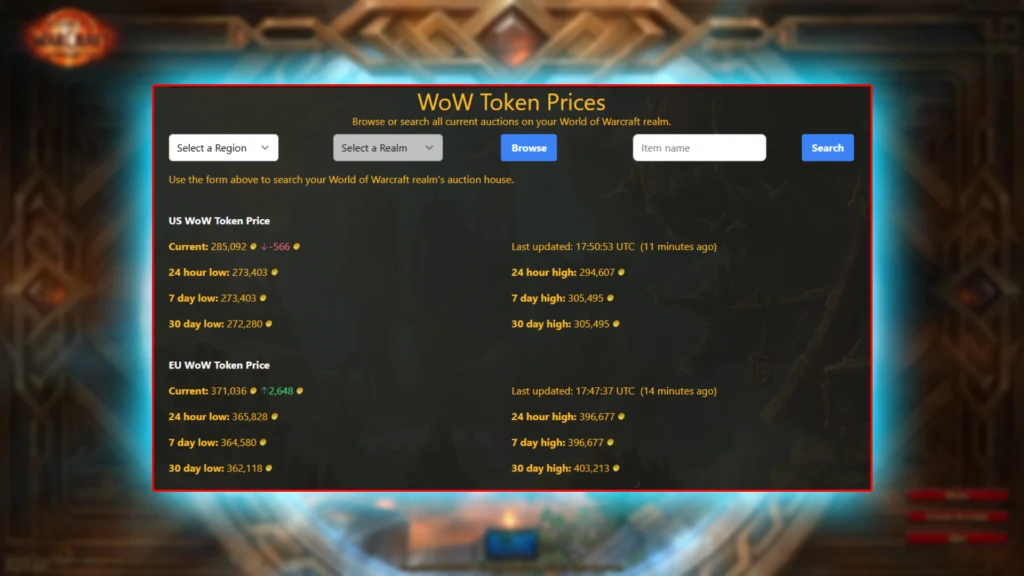
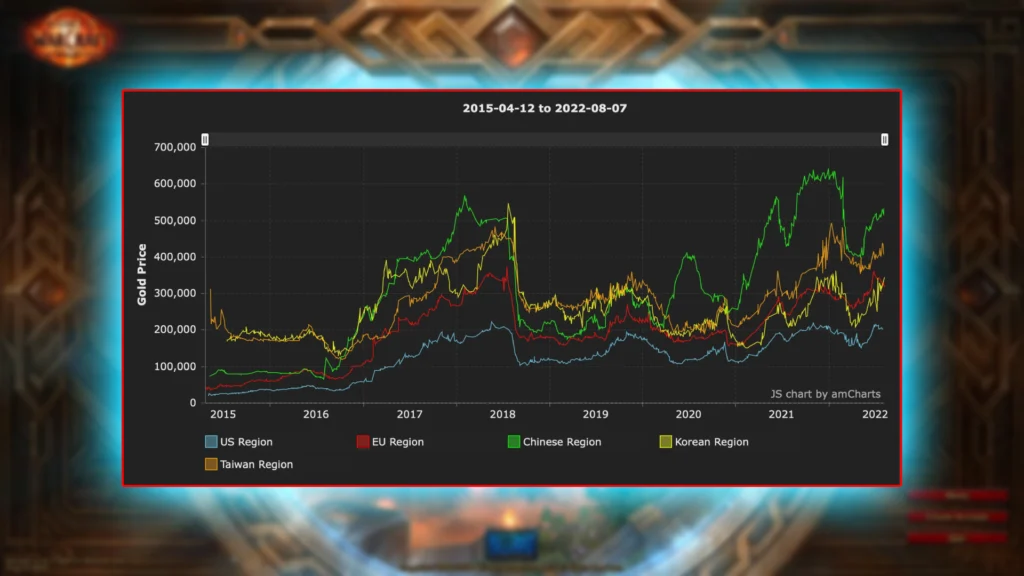
The WoW Token – Blizzard’s official gold-for-game-time exchange – is a bellwether for the game’s economic health. In 2025, WoW Token prices have hit record highs, reflecting the inflation and player behavior in The War Within. The token allows players to buy gold with real money (or vice versa), so its price in gold tends to rise when gold becomes more plentiful (or demand for gold increases). We’ve seen this clearly over the past year: the North American token price, which hovered around 200k–250k gold in late Shadowlands/Dragonflight, skyrocketed to over 400,000 gold after The War Within launch. In fact, NA token prices peaked at 402,169 gold (an all-time high) in one instance. Europe saw a similar trend with token prices jumping to about 436,068 gold at peak, also a record for that region. For context, Table 1 shows recent record token prices in major regions:
| Region | Record WoW Token Price (Gold) | Timeframe |
|---|---|---|
| North America (NA) | 402,169 gold | Late 2024/Early 2025 |
| Europe (EU) | 436,068 gold | Late 2024/Early 2025 |
| Taiwan (TW)** | 1,000,000+ gold | 2023-2024 (special case) |
Table 1: Record WoW Token prices by region during the War Within era. (TW saw extreme prices after an influx of players from China’s server closure, prompting special measures.)
These token price surges indicate that gold is becoming less valuable – you need far more gold now to equal the $20 (USD/Euro) value of a token. In other words, inflation lifts the token’s gold price. The WoW Token itself can influence inflation in a few ways. When tokens are expensive in gold, players who have stockpiled gold are more likely to spend that gold to buy tokens (for game time or Blizzard Balance). This removes gold from the economy (sinking it into Blizzard’s coffers), which can be mildly deflationary. Conversely, players seeing high token prices might be tempted to spend real money to buy a token and sell it for gold, injecting fresh gold (from other players’ pockets) into their own wallets – effectively redistributing existing gold. The token doesn’t create gold from thin air (it’s a gold exchange between players), but it facilitates converting real money into in-game purchasing power. In an inflationary environment, many players feel compelled to do exactly that. Some community members speculate Blizzard is content with high token prices, since it incentivizes purchasing tokens for cash (why earn gold slowly when $20 buys you a hefty sum?). Indeed, the WoW Token’s role as a pressure valve is significant: it offers a way to offset inflation for those willing to pay real money, while also potentially preventing gold inflation from getting too absurd by giving gold hoarders something to spend on (game time).
In response to extreme cases (like the Taiwan region token hitting 1 million gold), Blizzard has even imposed restrictions. In Taiwan, they restricted how tokens could be used (e.g. limiting conversion to Battle.net balance) once the prices went out of control. So far, other regions haven’t needed such drastic intervention, but the mere fact that tokens shattered records in NA/EU during The War Within has sparked inflation worries among players and Blizzard alike. The token’s price trends will be a key indicator to watch throughout 2025: if it continues climbing, it’s a sign that gold inflation is still accelerating in Azeroth’s economy.
Community Reactions and Influencer Insights
The WoW community has been actively discussing the economy changes in The War Within on forums, Reddit, and YouTube. Reactions range from frustration to adaptation. On official forums, some players criticized Blizzard’s approach to nerfing gold income. The argument is that Blizzard addressed symptoms (reducing new gold earnings) without removing existing gold, effectively making the rich richer (relatively) and the average player struggle. As one forum poster put it, “Nerfing the rate at which players can earn gold without touching how much gold is actually in existence is how ‘wage gaps’ are created in an economy.” In other words, veterans who already have millions feel little pain, while newcomers earn far less gold from the same activities, widening the wealth gap. This has led to resentment and the feeling that the economy is unfairly skewed.
On Reddit and community hubs, a common sentiment is surprise at just how expensive everything has become in 2025. Threads with titles like “I wasn’t expecting enchants/consumables to stay so expensive” capture the mood – many assumed prices would drop after the initial launch rush, only to find a month later that basic items still cost tens or hundreds of thousands of gold. Some players share tips on scraping by, such as focusing on self-sufficiency (e.g. leveling your own professions to avoid paying AH premiums) or gold farming methods (running old raids, gathering in new zones) to supplement income. Influencers and gold-making experts have also weighed in. Notably, gold-focused content creators like The Lazy Goldmaker have put out guides on how to thrive in this economy, emphasizing new gold-making opportunities created by the high demand for crafted gear and consumables. The overall tone from these experts is that opportunity exists amidst inflation – skilled traders can flip underpriced items or provide in-demand services to turn a profit, even as average players feel the pinch.
There’s also a thread of cynicism in community discussions. Whenever WoW Token prices spike or gold rewards are tweaked, some accuse Blizzard of deliberately manipulating the economy to boost token sales. For instance, when players noticed that the War Within expansion launched with unusually low WoW Token prices (in gold) for a new expansion, some theorized Blizzard might have throttled gold rewards to encourage token purchases. While Blizzard hasn’t confirmed such motives, this highlights the trust issues and close attention players pay to every economic tweak.
Despite complaints, some community members remain optimistic or at least undeterred. Wealthier players and guilds often shrug off inflation, since they have war-chests of gold and even benefit from rising prices (their stockpile appreciates in value relative to in-game goods). “Gold grinders” boasting millions of gold have turned to new goals, like hitting the gold cap or buying the new 3.1M gold mount, treating The War Within economy as a new challenge to master rather than a roadblock. In sum, the community response is mixed: frustration from those struggling with costs, excitement from those playing the markets, and a lot of discussion about Blizzard’s responsibility to maintain a healthy game economy.
Outlook for 2025: Inflation Forecast and Blizzard Interventions
What does the rest of 2025 hold for WoW’s economy? Based on current trends, we can expect gold inflation to continue, but its trajectory will depend on both player behavior and Blizzard’s actions. Here are a few predictions and possible interventions:
Continued Inflation (Moderating Over Time): As players progress through The War Within, more gold will naturally enter circulation from daily activities, dungeons, and quests (even if individually nerfed). By late 2025, average player gold holdings will likely be higher than today, which could keep upward pressure on prices. However, inflation may moderate compared to the initial expansion launch, since the early rush subsides and markets stabilize. We might not see another doubling of prices, but a steady creep upward in the cost of goods is likely unless significant measures are taken.
New Gold Sinks: Blizzard will probably introduce additional gold sinks to siphon excess gold out of the economy. The expansion already added the costly Crowd Pummeler 2-30 engineering mount (priced around 3.1 million gold in materials) as a luxury expense for the wealthy. We anticipate more such sinks in future patches – perhaps expensive vendor toys, transmog items, or even repair cost adjustments – to help pull gold out of circulation. Blizzard has a history of adding big-ticket items (e.g. the 5 million gold Brutosaur mount in BfA) as a form of soft currency regulation. These sinks target the richest players, helping curb inflation without directly harming the average player’s wallet.
Adjusting Gold Rewards: If Blizzard feels the gold generation nerfs went too far in stifling gameplay, they might slightly buff certain rewards. This could mean increasing gold from world quests or callings, or adding lucrative one-time quests in content patches. Conversely, if inflation continues unchecked, they could further reduce gold faucets (for example, nerfing gold from old raids or popular farms) to slow the influx. Striking a balance will be key – they’ll want new and casual players to feel they can earn enough gold to participate, while not flooding the economy. We might see dynamic tuning of rewards in patch notes throughout 2025 as Blizzard monitors economic data.
WoW Token Policy Changes: In extreme scenarios, Blizzard could tweak how the WoW Token works to combat inflation. One idea floated in the community is restricting token usage (as was temporarily seen in Taiwan and even tested in EU) – for instance, making tokens redeemable only for game time and not Battle.net Balance. This would reduce the incentive for converting massive amounts of gold into real-world value (which can drive up demand). Another possibility is regional token sale limits or cooldowns if prices get too volatile. These are drastic measures and Blizzard will likely avoid them unless absolutely necessary, since the token system is a real-money revenue stream. But the precedent in other regions shows that Blizzard is willing to step in if token prices or availability threaten the game’s economic stability.
Crackdown on Exploits and Bots: A critical intervention to keep inflation in check is aggressively targeting gold exploits and botting. In mid-late 2024, a gold-making exploit emerged that reportedly allowed some players to generate absurd amounts of gold (one notorious video touted a “1 billion gold per hour” trick). Blizzard responded by removing the illicit gold and items from the offenders and issuing bans. We predict Blizzard will continue a zero-tolerance approach in 2025 for any dupes or exploits that artificially swell the gold supply. Likewise, bans on bot networks (which farm and inject large volumes of gold) will be crucial. Each ban wave or hotfix against an exploit is effectively an emergency deflation tactic, preventing uncontrolled inflation from glitches.
Community-Driven Solutions: Players themselves might influence the economy’s course. If inflation makes the game feel too punishing, we could see community movements or feedback prompting change. Some players have even suggested in-game events where people can voluntarily sink gold for rewards – for example, a donation event (like a repeatable Ahn’Qiraj War Effort for gold) that grants titles or mounts for contributing gold. Such ideas, if implemented, would directly reduce the gold in circulation and show a collaborative approach to fighting inflation. It’s uncertain if Blizzard would adopt a player-suggested system like this, but it highlights that the player base is mindful of the issue and eager for solutions.

Conclusion
World of Warcraft: The War Within has undeniably impacted the in-game economy, ushering in a new wave of gold inflation that is being felt throughout 2025. Total gold generation remains high (even if tempered by design), and that excess gold is driving up prices of goods and services in Azeroth. The WoW Token’s record prices and Auction House trends serve as barometers of this economic shift. The community’s mixed reactions – from concern to clever entrepreneurship – show that while inflation poses challenges, it’s also become a dynamic part of the WoW gameplay experience. Going forward, the balance of inflation will hinge on Blizzard’s interventions (gold sinks, reward tuning, exploit fixes) and player-driven market adjustments. If managed well, the inflation can be kept to a reasonable roar; if left unchecked, it could erode the game’s accessibility for those without deep gold reserves.
Bottom line: The War Within has turned WoW’s economy into its own kind of endgame, where gold is king and its value is constantly in flux. Both players and Blizzard will need to stay vigilant in 2025 to ensure that Azeroth’s inflation dragon doesn’t spiral out of control – all while savvy goblins find ways to profit from the turmoil. By understanding the trends and reacting accordingly, the WoW community can weather this inflationary period and perhaps even thrive in it, one shiny coin at a time.